(this is an educational post only)
English proficiency level required for reading this post: intermediate
What does Trump’s March 1 Executive Order means for English learners?
TLDR: Trump’s March 1st Executive Order halts any further progress on increasing language assistance for people with Limited English Proficiency (LEP) when they deal with the federal US government or federally funded organizations.
Donald Trump signed an Executive Order (EO) on March 1, 2025 to make English the “official language of the United States of America”. Trump’s EO argues that making English the official US language will encourage a stronger national identity. But what does this EO mean for people with Limited English Proficiency (LEP) currently living in the United States?
Remember that “Executive orders, however, cannot override federal laws and statutes”.1 There is currently no federal law that makes English the official language of the United States, though 32 US states have designated English as their official state language.2
The official language mandate in these states serves as a way to preserve the use of English language above all other languages. Some of these states include California, Alabama, and Colorado.
Among the states that have made English an official language, there are also states that have other official languages in addition to English. For example, Hawaii has English and Hawaiian as official languages, whereas Alaska has over 21 other official languages.3
Trump’s Executive Order (EO) halts the initiative of Bill Clinton’s Executive Order from August 2000
For now, the main impact of Trump’s EO is that it prevents further progress of another EO, a 24-year-old Executive Order signed by former US President Bill Clinton called “Improving Access to Services for Persons with Limited English Proficiency”.
Clinton’s EO recognized the difficulties that people with LEP had in America whenever they dealt with the federal US government or federally funded organizations. This EO implemented different strategies to improve language assistance to people with LEP such as:
- appointing dedicated language assistance coordinators to federal government agencies such as the Departments of Labor and Justice,
- testing and verifying the language competency of hired linguists,
- providing language access training to public-facing federal employees, and
- making efforts to translate existing digital content into other languages, among many other initiatives4.
The main government agency that carried out the mandate of Clinton’s EO was the Federal Coordination and Compliance Section (otherwise known as FCS) of the Civil Rights Division, which is overseen by the Attorney General.

While Trump’s EO states that federal agencies and federally funded organizations are not required to remove, change, or stop current language assistance services and documents that they have prepared in other languages5, his EO does guide the Attorney General that “no further policy guidance on EO 13166 [Clinton’s EO] should be pursued.” This means that the federal government won’t be developing any new programs or other support to improve and expand language assistance for people with LEP for the time being.
Since Trump came into office on January 20th of this year, the Spanish-language version of the official White House website has been taken down.
Though Trump stated that he would restore the Spanish-language version, a Guardian article published on March 2nd stated that their journalists received no response from the White House about when that version of the website would be restored.
What can you do?
It depends on the federal agency that you’re using, and whether that agency still provides the language assistance programs from Clinton’s EO.
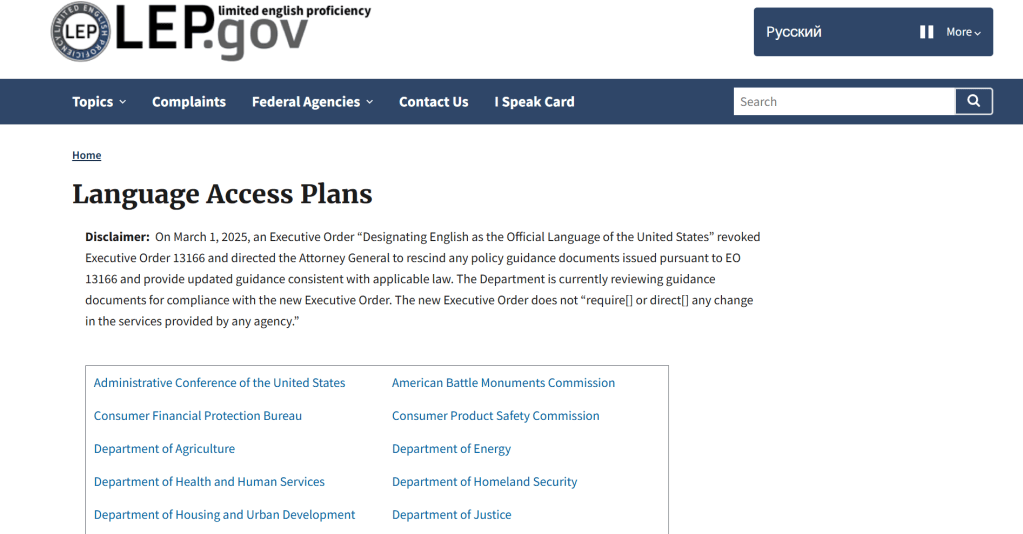
If you’re unsure, as of writing this post, the Limited English Proficiency website, is still up and available. You can browse their resources or contact them if you have questions. You can find a list of federal US government agencies that have language access plans on the Language Access Plans page.
Note: As of July 17, 2025, the LEP.gov website has been temporarily suspended.
You can also continue to improve your English-language skills by following one of the learning plans here.
Sources:
- “What Is an Executive Order and How Does it Work?” February 4, 2025: https://www.aclu.org/news/privacy-technology/what-is-an-executive-order-and-how-does-it-work ↩︎
- “Map of US states official English laws”.https://www.usenglish.org/us-states-official-english-laws/ ↩︎
- “Official languages of U.S. states and territories”: https://en.wikipedia.org/wiki/Template:Official_languages_of_U.S._states_and_territories ↩︎
- “A Snapshot of Federal Agency Language Access Progress”. August 12, 2024: https://www.lep.gov/sites/lep/files/media/document/2024-08/13166_Anniversary_FCS_LAP_review_snapshots_508.pdf ↩︎
- “Designating English as the Official Language of The United States”. March 1, 2025: https://www.whitehouse.gov/presidential-actions/2025/03/designating-english-as-the-official-language-of-the-united-states/ ↩︎

 English Ease Blog